
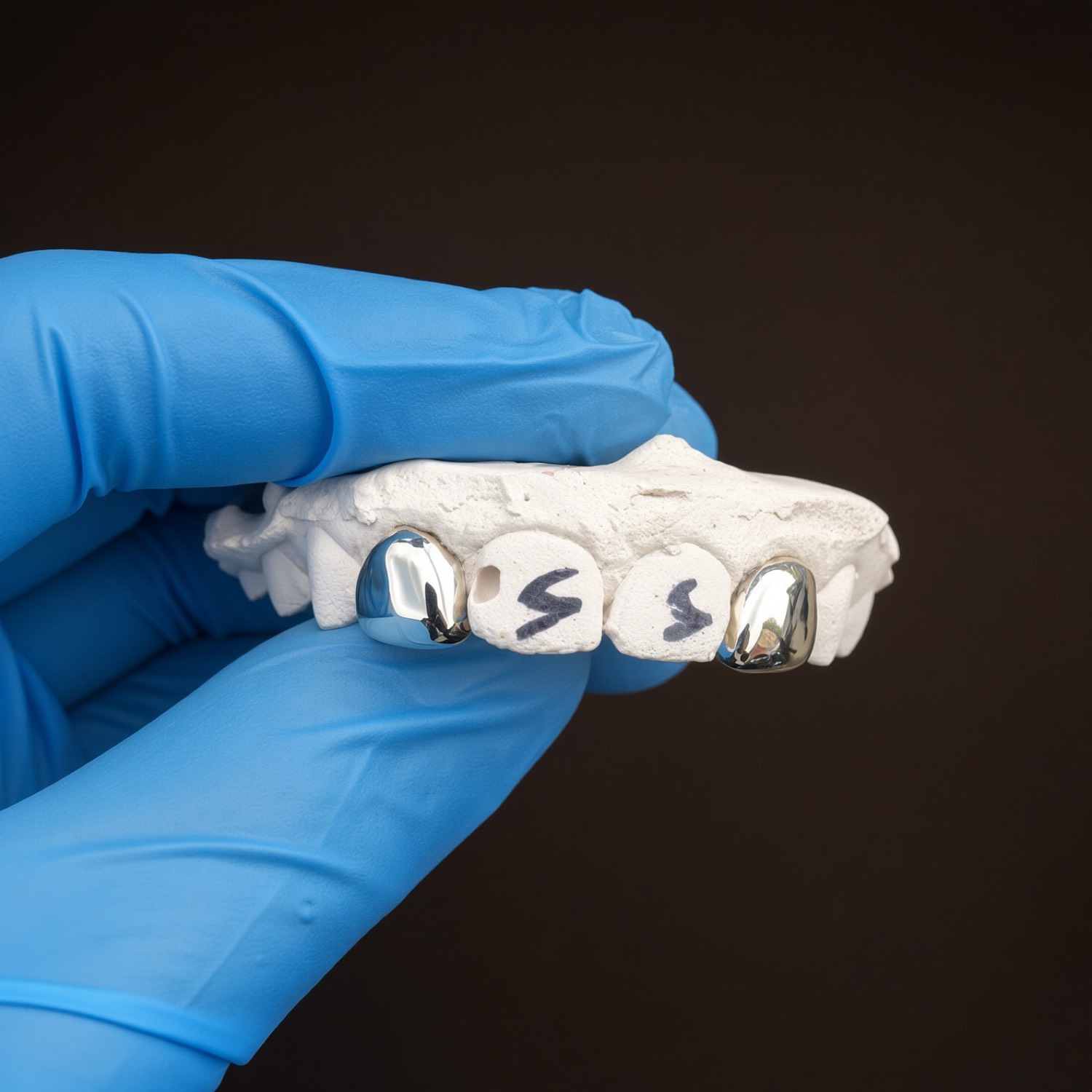
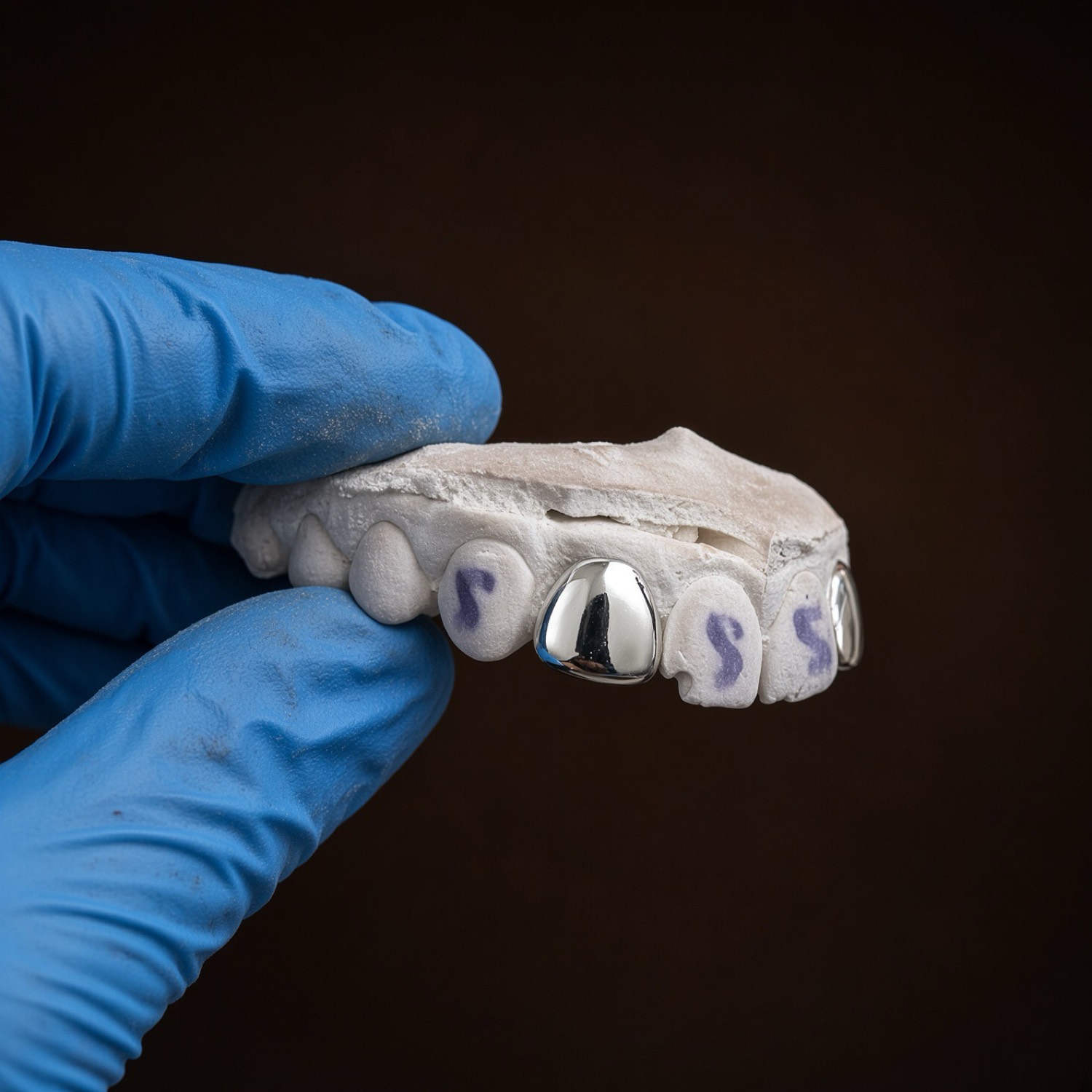
Made to your mould
£80.00
Mould kit £15.00, added in the total.
£80.00
Mould kit £15.00, added in the total.
A grill is one piece, made to the mould you send. It is not a ready-made set.
To place an order, write to [email protected] with what you want.
You choose the number of caps and the metal here. On the sheet in the kit, you mark which teeth they sit on. Plain caps are solid metal over each tooth. A bar joins the teeth into one piece of metal. A cutout, such as a heart or a window, leaves that shape open so the tooth shows through.
For diamonds, diamond dust, or more than 16 caps, contact us.
All four are solid precious metal, polished. They differ in colour, in how long that colour lasts, and in how hard the metal is.
Silver. Sterling silver is 925 parts silver in every 1,000. The rest is a hardening alloy. It is the brightest of the four, with a cool white shine. On the teeth it looks like white metal rather than gold. It can tarnish with wear, turning dull or dark where it meets air and skin. A silver polish brings the shine back. Silver has no karat.
Yellow gold. Yellow gold is gold mixed with silver and copper, and it keeps the warm yellow. More gold in the mix makes that yellow deeper. Less gold makes it a little paler.
White gold. White gold is gold mixed with white metals, which takes the yellow out. It looks pale and cool, closer to silver than to yellow gold, but it is still gold. It does not tarnish the way sterling silver does.
Rose gold. The pink comes from copper in the alloy, and it belongs to the metal itself. In 9k, where there is less gold, that copper shows more and the pink is stronger. In 18k the pink is softer, because more of the metal is gold.
9k, 14k and 18k. These apply to yellow, white and rose gold. The number is how many parts of pure gold are in every 24. 9k is 9 parts gold. It is the hardest wearing, the palest of the three, and the usual everyday gold in the UK. 14k is 14 parts gold, richer in colour than 9k and a little softer. 18k is 18 parts gold. The colour is the deepest, and the metal is the softest, so it can pick up fine marks sooner than 9k. Gold is denser than silver, so the same piece in gold has a little more weight, and more so at 18k than at 9k.
Each cap covers the tooth it is made for, up to the gum. The steps from the kit to the finished piece are on the process page.
We do not recommend eating or sleeping in them. They are jewellery, not a dental appliance. Take them out to eat, to sleep, and when you clean your teeth.